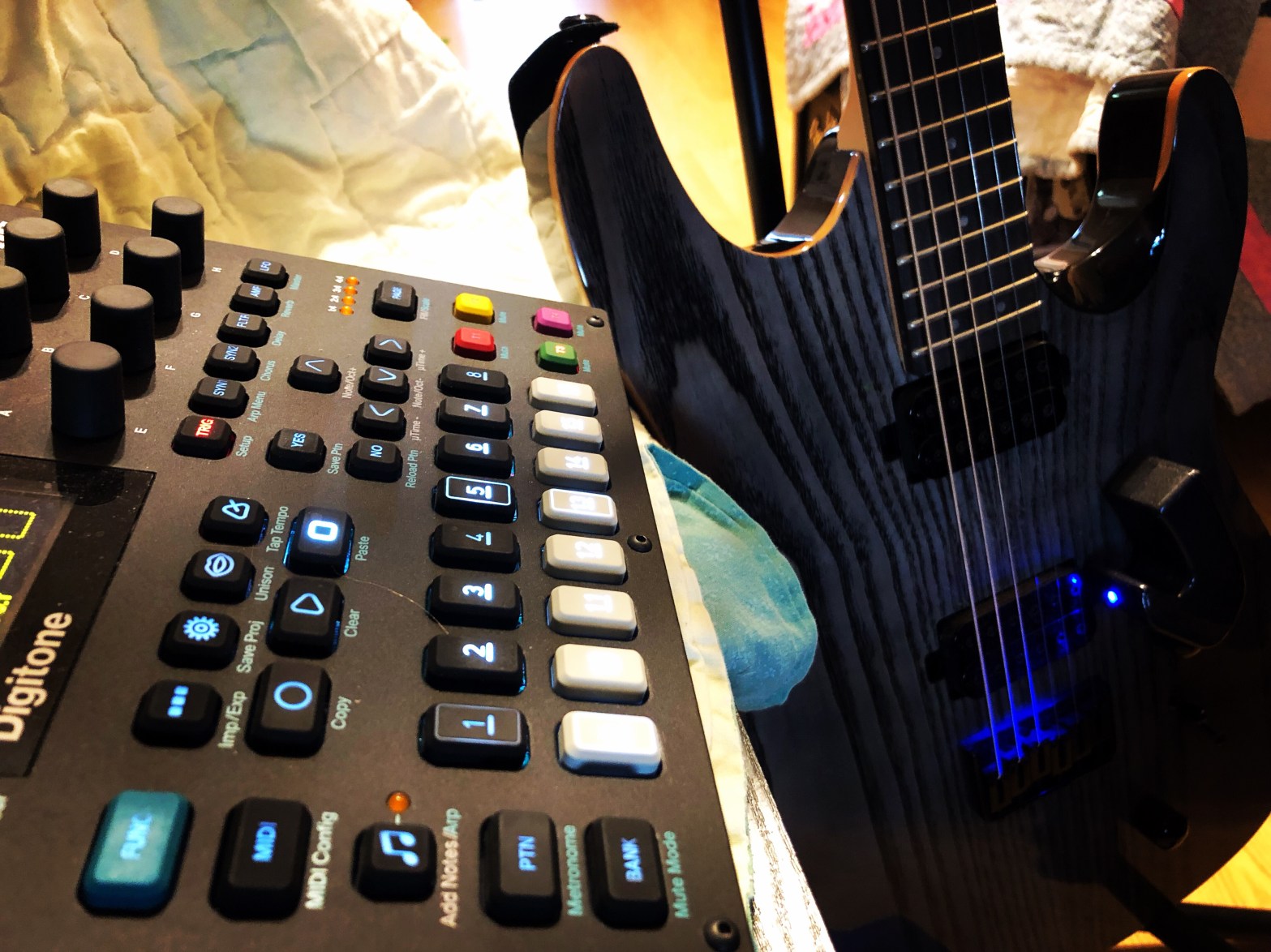
Sometimes a song starts as a concrete idea. But more often I find that they come from a place of abstraction; a sketch of a riff, a sound, a timbre, some tiny little atom of sound. If it manages to hold my attention long enough, then it might get recorded and saved for later. The piece I’ve been working on while live-streaming on Twitch is one of these.
The seed was a collection of four patterns I programmed into my Elektron Digitone while learning how to use it. The result was about 20 seconds of music which sounded vaguely like something you might find on a Tycho or Boards of Canada song. Having served it’s purpose as a tutorial, I moved on to making the patches and loops which were used in L. D. Blues, and the patterns just chilled in the Digitone memory for about a year.
When I decide to try and breathe life into one of these seeds, the first step is usually to just try and build on the original idea and see if I can flesh it out. It’s a bit like throwing paint at canvas: I start adding stuff without a clear idea where it’s going.
The original four patterns share a single percussion track, and come in pairs of alternate melodies over a I-ii chord progression. So after chaining the four patterns into a coherent sequence, I set about making alternate versions of the four-pattern sequence modulating into different scale modes. Chaining these all together gave me roughly five minutes of music to use as a framework to build upon.
Still working without a plan, I decided to try adding a baritone guitar to the sound. My Chapman ML1B has a nicely dark timbre on the neck pickup, which pairs well as a clean tone with spacey ambient echos and delay.
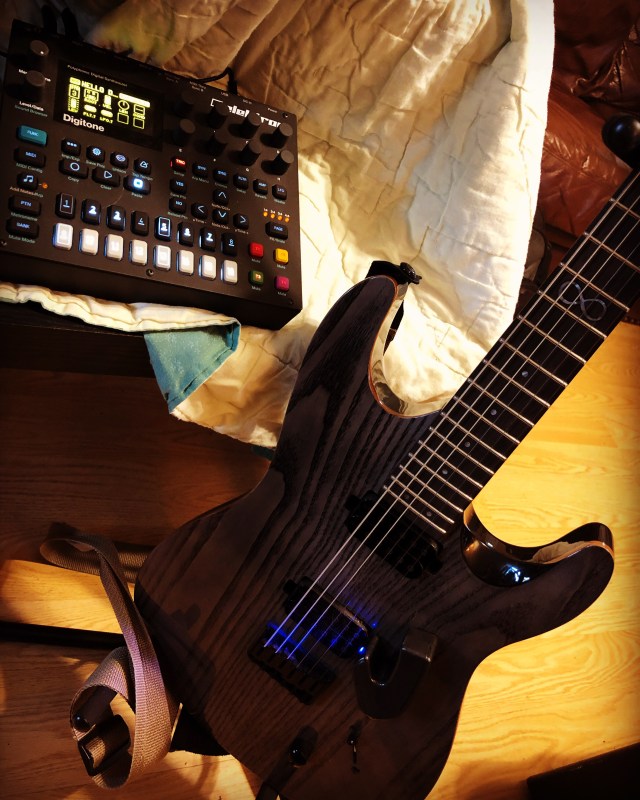
I threw on some arpeggiated chords in paired left-right tracks, which blend well with the Digitone patterns. Then I decided to start laying on some melodic lines using the ML1B and an E-Bow. This worked really nicely, resulting in a kinda moaning, almost Fuzz-like sound. (It’s actually the same clean tone as the arpeggiated chords with the tone knob on the guitar rolled way down).
With melodic parts added to roughly half of the song, I stopped work and bounced out a version to listen to for a while.
From here I could have simply finished filling in guitar melody and moved on to the next phase of cleaning things up and adding decoration and polish. The result would have been a modest little instrumental piece; a one-idea song that found a sound and dwelled in it for a bit. Nothing wrong with that, and if I’d stopped there I might have gone down that very road.
Instead I bounced a copy to listen to while tending to other duties knowing I’d be too busy with work and the final stages of the album launch to come back to the studio for a couple days. I find that listening to a work in progress outside of the studio can give a different perspective. In the studio I tend to drill in and focus on details, whereas in more relaxed or distracted contexts the broad strokes become more apparent. It also allows for spontaneous collisions with ideas from other places. Indeed, my listening over the last couple days has resulted in some insight into what the song wants to be, and also in a serendipitous collision of other musical ideas which I will attempt to work into the piece moving forward.
Listening to the mix as a whole, one impression that stands out is a sense of vast underwater depths. The first Digitone patch heard is a frothy pad sound with a filter sweep from low to high frequencies, giving an impression of rising bubbles. When the other Digitone tracks kick in, the long decay tails on the echo and reverb imply a sense of huge empty space. The guitar also plays through a long echoey delay with a tremolo modulation, adding to the sense of liquid ambience. The generally dark timbre of the instruments (aside from brief flashes of treble in the beat) helps to further sell the underwater feeling. The E-Bow melody, with it’s slow attack and relaxed timing result in a flowing, maybe even serpentine feel. Combined with the swung syncopation of the Digitone tracks, overall effect is a sense of smooth cruising motion through a vast underwater space.
Having noted the underwater theme, should I keep the piece instrumental or consider adding vocals. Lyric ideas are not abundant, but I am reminded of a trick that Kraftwerk employed on songs like Spacelab: very sparse vocals with vocoders on what were otherwise largely instrumental songs. This idea resonates because I’ve been on a Mr. Hudson kick lately and it has left me itching to put Vocalsynth through it’s paces and see what I can do with it.
So, something watery and gliding, with musical inspiration from Tycho and Kraftwerk. Time for a new working title? Trans-Atlantean something or other? Trance-Atlantean? “L” could be a kind of train reference (and a Tycho reference) but we’re veering into the rather obscure. Also Atlantis might have too many Aquaman overtones at the moment. Europe… Europa? Europa!
Europa is an idea that has legs. Potentially lots of them. The moon Europa has a surface of water ice which covers what is very likely a huge liquid water ocean heated by tidal deformation in the strong gravitational field of Jupiter. And it’s one of the best prospects for finding non-terrestrial life in the Solar System. Europa missions have been on the to-do list of planetary scientists for decades. The encounter of such a probe with some sort of Europan ocean dweller is a concept I can work with.
So now when I return to working on this song (new working title “Trance Europan Expression”), it will be in the context of a whole new set of ideas. It will mean restructuring and throwing a whole bunch of new paint at the canvas, but the process has shifted from largely unstructured tonal experimentation to more focused conceptually driven strategies. Still at the sketching stage, but I now have a shape and direction in mind. We shall see where it leads me.
 Dr. G and the Atomic Pawns